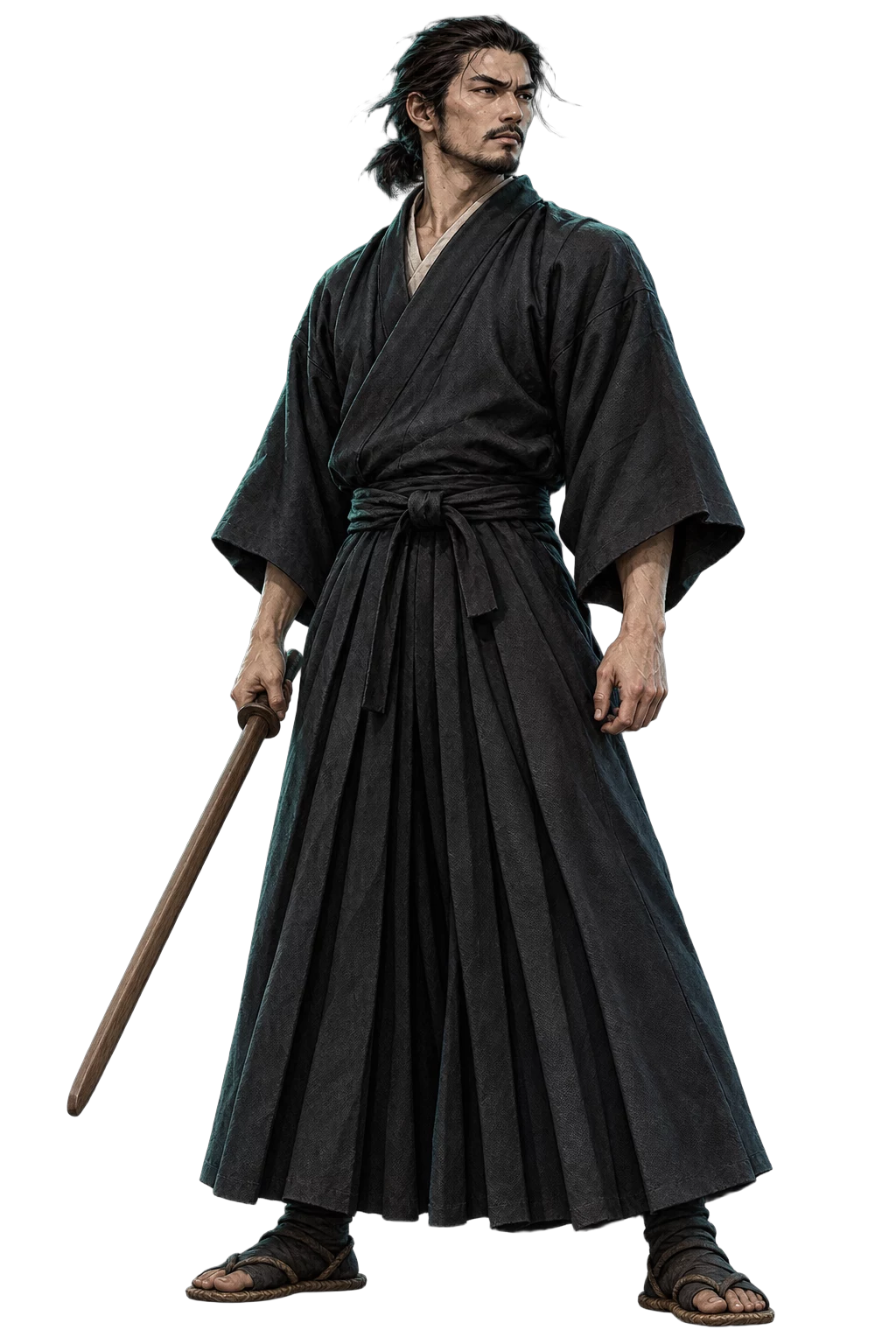
Dramatised portrait of Miyamoto Musashi holding a wooden sword

宮本武蔵

Miyamoto Musashi

The man behind the legend.

Swordsman. Strategist. A life retold.

Miyamoto Musashi was a swordsman from Harima who wrote The Book of Five Rings near the end of his life. He said he won more than sixty bouts without losing, but the details of those fights come mostly from accounts written long after.

Life
c.1582–84 — 1645
Affiliations
Niten Ichi-ryū, his own school; from 1640 supported by the Hosokawa family of Higo (Kumamoto)
Duel record
Sixty-odd bouts, "never once lost the advantage" (his own claim)
In the series
3 episode entries · Explore the episodes ↗

Born around 1582–84. The usual reading of his own age gives 1584; a family genealogy and the standard modern biography (Uozumi) prefer 1582. No birth record survives. Born in Harima province by his own words; the exact place is disputed.

Death date and calendar

19th day of the 5th lunar month, Shōhō 2 (13-06-1645 in the Gregorian calendar, probable). He was then living in Higo under the Hosokawa family's patronage.

A life in the record

The life of Miyamoto Musashi

22 events. The 10 key moments fill the screen; the others sit between them.

An empty plain of bare fields and still paddies at dawn, a red sun rising through the mist

01 / 101582 or 1584 · BirthHarima province

Born in Harima province

Born in Harima.

Evidence grade: Probable Disputed

His own starting point

In the preface to The Book of Five Rings, Musashi identifies his home as Harima. His statement that he was sixty in 1643 is normally read as a birth in 1584 under Japanese age reckoning. A family genealogy and Uozumi’s modern study favour 1582. Neither calculation supplies a surviving birth record.

A region, not a known birthplace

Several villages claim him. The map locates Harima broadly; it does not choose a village or reconstruct a childhood home. The biography below retains the competing birthplace traditions rather than resolving them through an illustration.

Historical record · Life event

1582 or 1584

Born in Harima province

WESTERN JAPANGeographic contextSETŌ INLAND SEAHarima provinceN
Evidence grade: Probable Harima, year window
Evidence grade: Traditional village

Born in Harima. The year is either 1584 (from his own "age 60 in 1643") or 1582 (Miyamoto family genealogy and Uozumi).

His own starting point

In the preface to The Book of Five Rings, Musashi identifies his home as Harima. His statement that he was sixty in 1643 is normally read as a birth in 1584 under Japanese age reckoning. A family genealogy and Uozumi’s modern study favour 1582. Neither calculation supplies a surviving birth record.

A region, not a known birthplace

Several villages claim him. The map locates Harima broadly; it does not choose a village or reconstruct a childhood home. The biography below retains the competing birthplace traditions rather than resolving them through an illustration.

Where the record is uncertain

Disputed: year

The village is disputed: Yoneda/Takasago, Miyamoto/Taishi, or Mimasaka-Miyamoto.

Supporting sources

  1. c.1592–93Age c.9Life event

    Expelled by his father

    A folk tale says his father Munisai threw a knife at the boy and drove him out.

    Evidence grade: Legend

    Historical record · Life event

    c.1592–93

    Expelled by his father

    Evidence grade: Legend The surviving account

    A childhood assembled later

    The knife-throwing story belongs to the later biographical tradition. It is not a childhood memory recorded by Musashi in The Book of Five Rings, and it cannot establish why he left his father or where he lived next.

    The limit of the account

    The 1727 text also places the boy with a maternal uncle who was a priest. A narrative written so long after the supposed events is evidence for the story being told, rather than a contemporary witness to this household.

    Where the record is uncertain

    Munisai does not appear in the Go Rin no Sho.

    Supporting sources

A seated swordsman and a boy with a wooden pole face each other inside a bamboo fence on a grey beach, a band of red cloud above

02 / 10c.1594–97 · Age 13 (his own count)Harima province

First duel: Arima Kihei

Musashi wrote that at thirteen he beat Arima Kihei of the Shintō-ryū.

Evidence grade: Confirmed

What Musashi actually left us

Writing near the end of his life, Musashi names Arima Kihei, identifies his school as Shintō-ryū and says that he beat him at thirteen. He does not describe the weapon, the ground, the spectators or Arima’s death. The claim was written roughly forty-seven years after the bout.

How the scene acquired its detail

The 1654 family inscription says he won at once. The Tanji Hōkin Hikki of 1727 supplies the challenge notice, the priest-uncle, the stick and the throw. These are layers of retelling, not independent eyewitness confirmation of the same choreography.

Why the map stays broad

The 1727 story puts the fight on a beach in Harima. The familiar bridge at Hirafuku belongs to later local tradition. A birth in 1582 also shifts the calculated year of a fight at thirteen; the date window remains about 1594–97.

Historical record · Duel

c.1594–97

First duel: Arima Kihei

Young Musashi with a wooden sword in the dramatised first film
Evidence grade: Confirmed that he claimed it
Evidence grade: Probable the bout
Evidence grade: Traditional the kill

Musashi wrote that at thirteen he beat Arima Kihei of the Shintō-ryū. He gives no other detail.

What Musashi actually left us

Writing near the end of his life, Musashi names Arima Kihei, identifies his school as Shintō-ryū and says that he beat him at thirteen. He does not describe the weapon, the ground, the spectators or Arima’s death. The claim was written roughly forty-seven years after the bout.

How the scene acquired its detail

The 1654 family inscription says he won at once. The Tanji Hōkin Hikki of 1727 supplies the challenge notice, the priest-uncle, the stick and the throw. These are layers of retelling, not independent eyewitness confirmation of the same choreography.

Why the map stays broad

The 1727 story puts the fight on a beach in Harima. The familiar bridge at Hirafuku belongs to later local tradition. A birth in 1582 also shifts the calculated year of a fight at thirteen; the date window remains about 1594–97.

Place this event on the map
WESTERN JAPANGeographic contextSETŌ INLAND SEAHarima provinceN

Where the record is uncertain

The year 1596 is a computation. The ink-on-the-notice story, the staff, the throw and Arima's death were first written down in 1727, about 130 years later. The Hirafuku location is legend.

Supporting sources

A lone young traveller climbs a misty mountain track beside a red azalea

03 / 10c.1599 · Age 16 (his own count)Tajima province

Beats Akiyama of Tajima

Musashi wrote that at sixteen he beat "a powerfully strong strategist" named Akiyama of Tajima.

Evidence grade: Confirmed

The second name in his account

Akiyama is one of the very few opponents Musashi names in his preface. He describes him as a strong strategist from Tajima and places the victory at sixteen. There is no surviving description of the contest in Musashi’s own words.

What the memorial adds

The Kokura inscription adds the season and a fatal outcome. It was commissioned by Musashi’s adopted son after his death. Tajima identifies Akiyama’s association; it does not establish the place of the fight, his school, his appearance or his biography.

Historical record · Duel

c.1599

Beats Akiyama of Tajima

WESTERN JAPANGeographic contextSETŌ INLAND SEATajima provinceN
Evidence grade: Confirmed that he claimed it
Evidence grade: Traditional the death

The second name in his account

Akiyama is one of the very few opponents Musashi names in his preface. He describes him as a strong strategist from Tajima and places the victory at sixteen. There is no surviving description of the contest in Musashi’s own words.

What the memorial adds

The Kokura inscription adds the season and a fatal outcome. It was commissioned by Musashi’s adopted son after his death. Tajima identifies Akiyama’s association; it does not establish the place of the fight, his school, his appearance or his biography.

Where the record is uncertain

The 1654 Kokura inscription adds "spring" and says Akiyama was killed. Akiyama's identity is unknown.

Supporting sources

  1. 1600Age c.17Life event

    Sekigahara campaign

    During the Sekigahara campaign Musashi was possibly with Kuroda Jōsui at Ishigakihara in Bungo.

    Evidence grade: Traditional

    Historical record · Life event

    1600

    Sekigahara campaign

    Evidence grade: Traditional The surviving account

    A campaign is not a confirmed battlefield

    Musashi is frequently placed at the famous battle of Sekigahara. The project’s research instead treats possible service with Kuroda Jōsui in Kyushu as a qualified interpretation. His father’s connections help explain that possibility; they do not prove Musashi’s own presence.

    Keep the gap visible

    The surviving record does not justify selecting an army, a tactical role or a dramatic moment for him on the main battlefield. The entry records a disputed part of his military biography, rather than a documented battle scene.

    Where the record is uncertain

    His father Munisai's Kuroda service is probable.

    Supporting sources

A young swordsman crosses a long wooden bridge into Kyoto at dusk, a red lantern ahead

04 / 10c.1604 · Age 21 (his own count)Kyoto

Kyoto: the strategists of the realm

Musashi wrote that at 21 (22 in some copies) he went to the capital, fought several bouts with famous strategists and never lost.

Evidence grade: Confirmed

The capital in his own words

The Book of Five Rings says that he went to the capital at twenty-one and met strategists from across the country without losing. Some copies give twenty-two. The year is worked back from that age, not supplied by a dated Kyoto diary.

Names supplied by the family

The later Kokura inscription connects these contests with the Yoshioka house. Keeping the two sources apart matters: Musashi’s claim establishes what he said about his successes, while the inscription supplies the familiar opponents and sequence.

Historical record · Duel

c.1604

Kyoto: the strategists of the realm

WESTERN JAPANGeographic contextSETŌ INLAND SEAKyotoN
Evidence grade: Confirmed that he claimed it
Evidence grade: Probable Yoshioka identity

Musashi wrote that at 21 (22 in some copies) he went to the capital, fought several bouts with famous strategists and never lost. He names nobody.

The capital in his own words

The Book of Five Rings says that he went to the capital at twenty-one and met strategists from across the country without losing. Some copies give twenty-two. The year is worked back from that age, not supplied by a dated Kyoto diary.

Names supplied by the family

The later Kokura inscription connects these contests with the Yoshioka house. Keeping the two sources apart matters: Musashi’s claim establishes what he said about his successes, while the inscription supplies the familiar opponents and sequence.

Where the record is uncertain

The opponents are probably the Yoshioka house. The year is computed.

Supporting sources

  1. c.1604–05Age c.21–22DuelKyoto

    The Yoshioka brothers

    The 1654 inscription says Musashi beat Seijūrō with one stroke, took a wooden sword from Denshichirō and killed him with it, then routed Matashichirō and hundreds of men at Shimomatsu.

    Evidence grade: Traditional Disputed

    Historical record · Duel

    c.1604–05

    The Yoshioka brothers

    Dramatised film still of hands holding a wooden sword
    Evidence grade: Traditional The surviving account
    Evidence grade: Legend 1684 counter-tradition

    The family’s sequence

    The Kokura inscription, erected in 1654, names the Yoshioka encounters: Seijūrō, Denshichirō and the young Matashichirō with a large following. Its account is the foundation of the familiar escalation from contest to confrontation. Musashi’s own text never identifies these men.

    A competing memory

    The Yoshioka tradition gives a different outcome, and the 1684 tale may not even refer to the same Musashi. The famous claim that he destroyed the entire house also exceeds the record: a Yoshioka heir appears in an account of an incident in 1614.

    What the location can tell us

    Kyoto is the setting associated with these accounts. A regional locator can orient the reader, but it cannot authenticate the later fight sites, the number of attackers or the mechanics of an ambush.

    Place this event on the map
    WESTERN JAPANGeographic contextSETŌ INLAND SEAKyotoN

    Where the record is uncertain

    Disputed: versions

    Musashi never names the Yoshioka. A 1684 Yoshioka tale gives a draw with a "Miyamoto Musashi" who is not clearly the same man; it may be a creation. The house did not perish: a Yoshioka heir is recorded in 1614.

    Supporting sources

  2. 1605 and 1607Age c.22–24Writing

    Heidō kagami

    A text attributed to Musashi.

    Evidence grade: Legend Disputed

    Historical record · Writing

    1605 and 1607

    Heidō kagami

    Evidence grade: Legend The surviving account

    An attribution under examination

    Heidō kagami is associated with Musashi and the dates 1605 and 1607, but its authorship is disputed. Uozumi discusses it; the project’s research also records Ōkura’s rejection of the attribution. A title appearing in a chronology does not settle its author.

    A different kind of uncertainty

    Here the central problem is the text’s attribution, rather than an approximate date alone. It should not be treated as a securely dated window into the young Musashi’s thinking.

    Where the record is uncertain

    Disputed: authorship

    Authorship is disputed. Ōkura rejects it; Uozumi discusses it (pp.41-48).

    Supporting sources

  3. 1607Age c.24Life event

    Munisai's Tōri-ryū licence

    His father Munisai issues a Tōri-ryū licence to Tomooka Kanjūrō, a Hosokawa retainer, in Buzen/Bungo.

    Evidence grade: Confirmed

    Historical record · Life event

    1607

    Munisai's Tōri-ryū licence

    Evidence grade: Confirmed extant document

    A document about his father

    The surviving licence links Munisai with Tomooka Kanjūrō, a Hosokawa retainer, in the Buzen–Bungo sphere. The project knows this document through the research cited in the modern study, rather than a new examination of the original.

    Context, not a movement record

    The licence is useful evidence for the family’s martial and service connections. It is not a dated record placing Musashi himself in the same room or showing that he held the same employment.

    About the evidence

    The document survives.

    Supporting sources

Two swordsmen face each other on a low, flat island in a grey strait, boats at the shore, a red sun in the mist

05 / 101612 · Age c.29Funashima

Ganryūjima (Funashima)

Musashi kills a swordsman called Ganryū on the island of Funashima with one blow of a wooden sword (1654 inscription).

Evidence grade: Probable Disputed

The oldest detailed version

The 1654 family inscription describes a swordsman called Ganryū, a steel blade and Musashi’s wooden sword. It places the encounter on Funashima and gives Musashi victory with one blow. It is a memorial account written after his death, not his own description of the duel.

Accounts that do not agree

A Numata-family record of 1672 says the beaten opponent revived and was killed by Musashi’s pupils. That changes the familiar solitary victory. Other traditions give different years, while the full name Sasaki Kojirō and the precise lunar date appear much later.

The famous scene is a later layer

The boat-oar sword and other dramatic details entered the written tradition long after the fight. The locator shows the island’s regional setting; the artwork is a dramatised scene, not a reconstruction established by surviving evidence.

Historical record · Duel

1612

Ganryūjima (Funashima)

Dramatised illustration of a boat on a misty beach
Evidence grade: Probable the fight
Evidence grade: Traditional 1612

The oldest detailed version

The 1654 family inscription describes a swordsman called Ganryū, a steel blade and Musashi’s wooden sword. It places the encounter on Funashima and gives Musashi victory with one blow. It is a memorial account written after his death, not his own description of the duel.

Accounts that do not agree

A Numata-family record of 1672 says the beaten opponent revived and was killed by Musashi’s pupils. That changes the familiar solitary victory. Other traditions give different years, while the full name Sasaki Kojirō and the precise lunar date appear much later.

The famous scene is a later layer

The boat-oar sword and other dramatic details entered the written tradition long after the fight. The locator shows the island’s regional setting; the artwork is a dramatised scene, not a reconstruction established by surviving evidence.

Place this event on the map
WESTERN JAPANGeographic contextSETŌ INLAND SEAFunashimaN

Where the record is uncertain

Disputed: date and details

Other accounts give 1601 or 1602. A 1672 record says Musashi's pupils killed the beaten man. The full name "Sasaki Kojirō" first appears in 1776; the oar sword first appears in 1716. The day 13 April 1612 (lunar) comes from 1776.

Supporting sources

  1. 1614–15Age c.31–32Life event

    Osaka campaigns

    Musashi is said to have taken part in the Osaka campaigns.

    Evidence grade: Traditional

    Historical record · Life event

    1614–15

    Osaka campaigns

    Evidence grade: Traditional The surviving account

    Service without a clear role

    Later accounts associate Musashi with the Osaka campaigns, but the early evidence is too vague to reconstruct his service confidently. His own short account of youthful bouts does not supply a military memoir.

    What remains unresolved

    The entry does not assign him a battle formation, commander, side or feat of arms. These would turn a broad biographical association into a scene the cited record cannot sustain.

    Where the record is uncertain

    The early sources are vague.

    Supporting sources

  2. 1632Age c.49Life eventKokura area

    With the Ogasawara at Kokura

    Ogasawara Tadazane moves to Kokura.

    Evidence grade: Probable

    Historical record · Life event

    1632

    With the Ogasawara at Kokura

    WESTERN JAPANGeographic contextSETŌ INLAND SEAKokura areaN
    Evidence grade: Probable The surviving account

    Ogasawara Tadazane moves to Kokura. Iori and Musashi are linked to his house.

    A household connection

    Ogasawara Tadazane’s move to Kokura provides the setting for Musashi’s association with that house. His adopted son Iori’s service is an important part of this connection. It is a different picture from an entirely isolated swordsman outside every lordly network.

    Separate their careers

    Iori’s position does not automatically establish Musashi’s rank or duties. The project treats Musashi’s movements and attachments here through modern research, rather than filling gaps with an assumed continuous retainer’s career.

    Supporting sources

An older swordsman on a frosty slope looks across the bay at the ruined Hara castle, a red camellia on a branch

06 / 101637–38 · Age c.54–55

Shimabara rebellion

Musashi serves as an adviser to Ogasawara Nagatsugu.

Evidence grade: Confirmed

An unusually tangible trace

The research associates Musashi with Ogasawara Nagatsugu as an adviser during the rebellion. A letter to Arima Naozumi survives and is held at the Yoshikawa Eiji Memorial Museum. The surviving correspondence makes this episode firmer than many of his supposed earlier campaigns.

Reading through the research

The project’s account of the letter is mediated through the cited scholarship; the original was not examined for this page. It supports a qualified account of service, without licensing invented battlefield choreography or a heroic command role.

Historical record · Life event

1637–38

Shimabara rebellion

Evidence grade: Confirmed letter

Musashi serves as an adviser to Ogasawara Nagatsugu. A letter from Musashi to Arima Naozumi survives.

An unusually tangible trace

The research associates Musashi with Ogasawara Nagatsugu as an adviser during the rebellion. A letter to Arima Naozumi survives and is held at the Yoshikawa Eiji Memorial Museum. The surviving correspondence makes this episode firmer than many of his supposed earlier campaigns.

Reading through the research

The project’s account of the letter is mediated through the cited scholarship; the original was not examined for this page. It supports a qualified account of service, without licensing invented battlefield choreography or a heroic command role.

About the evidence

The letter is held at the Yoshikawa Eiji Memorial Museum.

Supporting sources

A small figure walks a road through rice fields toward Kumamoto castle under a low red sun

07 / 101640 (Kan'ei 17) · Age c.57Higo / Kumamoto

Invited to Kumamoto by the Hosokawa

Musashi writes to Nagaoka Okinaga (18th day, 7th month, lunar).

Evidence grade: Confirmed

From travel to patronage

An autograph letter to Nagaoka Okinaga survives at Yatsushiro. Its placement in 1640 is estimated. Together with the research on the Hosokawa household, it anchors Musashi’s late-life connection with Higo more firmly than many stories about his youth.

Support in stages

The recorded provisions are not interchangeable descriptions of a single grant. The research distinguishes an initial allowance from a later order for rice. Those figures are taken through modern scholarship; the underlying Hosokawa order was not examined by the project.

Do not equate support with rank

Later biography describes guest status and a residence at the Chiba castle site. Receiving support does not, by itself, demonstrate the precise rank or ordinary vassalage sometimes assigned to him.

Historical record · Life event

1640 (Kan'ei 17)

Invited to Kumamoto by the Hosokawa

WESTERN JAPANGeographic contextSETŌ INLAND SEAHigo / KumamotoN
Evidence grade: Confirmed letter
Evidence grade: Probable invitation and stipend

Musashi writes to Nagaoka Okinaga (18th day, 7th month, lunar). Lord Hosokawa Tadatoshi invites him to Higo (8th month) and gives him a stipend of 7-nin fuchi and 18 koku. An order for 300 koku of rice follows on the 5th day of the 12th month (about mid-January 1641).

From travel to patronage

An autograph letter to Nagaoka Okinaga survives at Yatsushiro. Its placement in 1640 is estimated. Together with the research on the Hosokawa household, it anchors Musashi’s late-life connection with Higo more firmly than many stories about his youth.

Support in stages

The recorded provisions are not interchangeable descriptions of a single grant. The research distinguishes an initial allowance from a later order for rice. Those figures are taken through modern scholarship; the underlying Hosokawa order was not examined by the project.

Do not equate support with rank

Later biography describes guest status and a residence at the Chiba castle site. Receiving support does not, by itself, demonstrate the precise rank or ordinary vassalage sometimes assigned to him.

Where the record is uncertain

The letter survives at Yatsushiro; its 1640 dating is estimated. The stipend figures come from Uozumi and Ōkura; the Hosokawa document was not seen.

Supporting sources

  1. 1641 (2nd month, lunar)Age c.58Writing

    Hyōhō sanjūgo kajō

    A strategy text attributed to Musashi, said to have been presented in this month.

    Evidence grade: Traditional Disputed

    Historical record · Writing

    1641 (2nd month, lunar)

    Hyōhō sanjūgo kajō

    Evidence grade: Traditional The surviving account

    A text associated with the Hosokawa years

    The Thirty-five Articles of Strategy is traditionally placed in the second lunar month of 1641. Its association with Musashi is discussed in the modern research, but some scholars consider it a later forgery.

    What the date cannot prove

    A traditional presentation date is not proof of authorship. The entry retains that attribution problem instead of treating the work as an undisputed first draft of The Book of Five Rings.

    Where the record is uncertain

    Disputed: authorship

    Some call it a later forgery.

    Supporting sources

  2. 26-04-1641Age c.58Life event

    Hosokawa Tadatoshi dies

    Tadatoshi dies (17th day, 3rd month, Kan'ei 18, lunar).

    Evidence grade: Confirmed

    Historical record · Life event

    26-04-1641

    Hosokawa Tadatoshi dies

    Evidence grade: Confirmed the death
    Evidence grade: Probable support continues

    Tadatoshi dies (17th day, 3rd month, Kan'ei 18, lunar). His son Mitsunao continues Musashi's support.

    A change of patron

    The research dates Tadatoshi’s death to the seventeenth day of the third lunar month of Kan’ei 18. His son Mitsunao continued Musashi’s support. The transition therefore did not simply end Musashi’s connection with the Hosokawa household.

    Calendar and source limits

    The displayed Gregorian equivalent comes through the secondary research noted below. It should not be confused with a direct transcription of a Western-calendar date in a contemporary record.

    Where the record is uncertain

    The Gregorian date comes from Japanese Wikipedia.

    Supporting sources

  3. 1641–43Age c.58–60Life event

    Quiet years in Kumamoto

    Later accounts show him teaching, in Zen circles, and making ink paintings and crafts.

    Evidence grade: Traditional

    Historical record · Life event

    1641–43

    Quiet years in Kumamoto

    Evidence grade: Traditional The surviving account

    A life beyond the duel stories

    Later biographies describe teaching, Zen associations, painting and crafts in Kumamoto. These interests help explain the familiar image of Musashi as an artist as well as a strategist, but few dated documents fill these years.

    Resist an invented daily routine

    The surviving material does not give a continuous diary. It cannot establish a particular daily training ground, studio routine or conversation. Such scenes belong to visual interpretation and must be labelled accordingly.

    Where the record is uncertain

    The record is thin. Few dated documents survive.

    Supporting sources

Before dawn, a tiny figure bows on a forest ridge above a sea of mist, a red maple beside him

08 / 101643 (10th month, lunar) · Age 60 (his own count)Higo / Kumamoto

Begins the Go Rin no Sho

In the preface Musashi says he climbed Mt Iwato in Higo, bowed to heaven and to Kannon, and began to write The Book of Five Rings.

Evidence grade: Confirmed

A beginning named in the preface

Musashi’s preface places the start in the tenth lunar month of 1643. He says that he climbed Mount Iwato in Higo and began to write after paying his respects to heaven and Kannon. This is strong evidence for what the text claims about its own beginning.

The manuscript and the cave are different questions

No autograph of the book survives; the work is transmitted in copies. The familiar story of years spent living in Reigandō is not stated in the preface. Later accounts and modern tourism descriptions should not be silently substituted for those words.

A setting with competing traditions

Another tradition places the writing at a house in Funatsu. The project has not established the origin of the cave-residence story. It leaves that gap visible rather than giving the book an invented uninterrupted cave-writing scene.

Historical record · Writing

1643 (10th month, lunar)

Begins the Go Rin no Sho

WESTERN JAPANGeographic contextSETŌ INLAND SEAHigo / KumamotoN
Evidence grade: Confirmed the preface
Evidence grade: Traditional cave residence

A beginning named in the preface

Musashi’s preface places the start in the tenth lunar month of 1643. He says that he climbed Mount Iwato in Higo and began to write after paying his respects to heaven and Kannon. This is strong evidence for what the text claims about its own beginning.

The manuscript and the cave are different questions

No autograph of the book survives; the work is transmitted in copies. The familiar story of years spent living in Reigandō is not stated in the preface. Later accounts and modern tourism descriptions should not be silently substituted for those words.

A setting with competing traditions

Another tradition places the writing at a house in Funatsu. The project has not established the origin of the cave-residence story. It leaves that gap visible rather than giving the book an invented uninterrupted cave-writing scene.

Where the record is uncertain

No autograph survives. The preface does not mention a cave. That he lived in the Reigandō cave is a tradition of unknown origin; another view places the writing at a house in Funatsu.

Supporting sources

  1. 1644 (11th month, lunar)Age c.61Life event

    Falls ill

    Musashi falls ill.

    Evidence grade: Probable

    Historical record · Life event

    1644 (11th month, lunar)

    Falls ill

    Evidence grade: Probable The surviving account

    Musashi falls ill. Lord Mitsunao sends doctors.

    The documented period is late

    The research places the illness in the eleventh lunar month of 1644 and records that Mitsunao sent doctors. The relevant letters are known through scholarship and were not examined directly by the project.

    No retrospective diagnosis

    Nothing in the early material examined for the research established a named disease. Popular claims of cancer do not provide a traceable early diagnosis. The entry therefore says that Musashi fell ill, without projecting that illness back across his whole time in Kumamoto.

    Where the record is uncertain

    No Edo-period text naming the illness was found. "Cancer" appears only on modern profile pages; its origin is unverified.

    Supporting sources

An old man sits at a low desk with a scroll in a large dim room, open doors onto a rainy garden

09 / 101645 (12th day, 5th month, lunar) · Age c.62

Dokkōdō for Terao Magonojō

Musashi signs the Dokkōdō, 21 short precepts, for his pupil Terao Magonojō.

Evidence grade: Confirmed

A surviving object

The Dokkōdō is a short set of twenty-one precepts. Unlike the lost original of The Book of Five Rings, the scroll survives in Kumamoto. It bears Musashi’s name and is addressed to his pupil Terao Magonojō.

Text, colophon and later biography

The colophon’s handwriting has been questioned, so the exact dating remains qualified. The familiar account that Musashi handed over The Book of Five Rings on the same day comes from biographies written much later. Those are separate claims with different evidential foundations.

Historical record · Writing

1645 (12th day, 5th month, lunar)

Dokkōdō for Terao Magonojō

Evidence grade: Confirmed the scroll
Evidence grade: Probable date
Evidence grade: Traditional Go Rin no Sho hand-over

Musashi signs the Dokkōdō, 21 short precepts, for his pupil Terao Magonojō. The scroll survives in Kumamoto.

A surviving object

The Dokkōdō is a short set of twenty-one precepts. Unlike the lost original of The Book of Five Rings, the scroll survives in Kumamoto. It bears Musashi’s name and is addressed to his pupil Terao Magonojō.

Text, colophon and later biography

The colophon’s handwriting has been questioned, so the exact dating remains qualified. The familiar account that Musashi handed over The Book of Five Rings on the same day comes from biographies written much later. Those are separate claims with different evidential foundations.

Where the record is uncertain

The colophon may be in another hand, so the date is probable. Biographies written about 110 years later say he gave Terao the Go Rin no Sho on the same day.

Supporting sources

An empty veranda of a modest house in the rain, a red pomegranate in flower, the castle faint in the mist

10 / 1013-06-1645 · Age 62 (64 if born 1582)Higo / Kumamoto

Death in Kumamoto

Musashi dies on the 19th day of the 5th month, Shōhō 2 (lunar).

Evidence grade: Confirmed

Keep the calendars distinct

The death date is the nineteenth day of the fifth lunar month of Shōhō 2. Writing it simply as 19 May would turn a Japanese lunar date into an incorrect Gregorian one. The page retains 13 June 1645 as a probable Gregorian conversion.

How the life was remembered

Musashi’s adopted son Iori commissioned the Kokura memorial in 1654. That family inscription became a central source for his fights and legacy, but it was erected after his death and is not a neutral eyewitness biography of every episode.

Historical record · Life event

13-06-1645

Death in Kumamoto

WESTERN JAPANGeographic contextSETŌ INLAND SEAHigo / KumamotoN
Evidence grade: Confirmed the death
Evidence grade: Probable Gregorian date

Keep the calendars distinct

The death date is the nineteenth day of the fifth lunar month of Shōhō 2. Writing it simply as 19 May would turn a Japanese lunar date into an incorrect Gregorian one. The page retains 13 June 1645 as a probable Gregorian conversion.

How the life was remembered

Musashi’s adopted son Iori commissioned the Kokura memorial in 1654. That family inscription became a central source for his fights and legacy, but it was erected after his death and is not a neutral eyewitness biography of every episode.

Where the record is uncertain

The Gregorian day 13-06-1645 is probable, not certain. It is not 19 May.

Supporting sources

  1. after 13-06-1645Life eventHigo / Kumamoto

    Funeral and tomb

    His funeral is held at Taishōji.

    Evidence grade: Probable Disputed

    Historical record · Life event

    after 13-06-1645

    Funeral and tomb

    WESTERN JAPANGeographic contextSETŌ INLAND SEAHigo / KumamotoN
    Evidence grade: Probable funeral
    Evidence grade: Legend armour burial

    His funeral is held at Taishōji. A tomb stone stands at Musashizuka, Kumamoto.

    Memorial landscape

    Musashizuka is a real place of commemoration in Kumamoto. Later accounts connect the funeral with Taishōji. A surviving monument and a local tradition can be described without treating every burial story as an excavated fact.

    Traditions that compete

    One account places the body at Musashizuka; another associates the remains with the Terao graves and says only a sword was buried at the better-known site. The upright burial in armour is a further legendary layer whose first source the project has not established.

    Where the record is uncertain

    Disputed: burial place

    A rival tradition says only his sword is buried there and his body lies at the Terao family graves. The story that he was buried upright in armour, watching over his lord's road, is legend. Its first source is unknown.

    Supporting sources

The story and its sources

Where history becomes legend.

Three familiar stories. Different layers of evidence.

01

c.1594–97

First duel: Arima Kihei

Explore this event ↓

The popular story

The boy kills a grown swordsman after defacing his challenge notice. The whole scene is often retold as though Musashi recorded it himself.

Later tradition

What the evidence says

Musashi wrote that at thirteen he beat Arima Kihei of the Shintō-ryū. He gives no other detail.

The year 1596 is a computation. The ink-on-the-notice story, the staff, the throw and Arima's death were first written down in 1727, about 130 years later. The Hirafuku location is legend.

Our retelling

Musashi’s First Fight follows the later 1727 narrative and attributes the death to later accounts. Faces, staging and movement between the recorded beats are dramatised.

Musashi’s First Fight ↗
02

c.1604–05

The Yoshioka brothers

Explore this event ↓

The popular story

Musashi destroys the Yoshioka school in a succession of duels and an overwhelming ambush.

Later tradition

What the evidence says

The 1654 inscription says Musashi beat Seijūrō with one stroke, took a wooden sword from Denshichirō and killed him with it, then routed Matashichirō and hundreds of men at Shimomatsu.

Musashi never names the Yoshioka. A 1684 Yoshioka tale gives a draw with a "Miyamoto Musashi" who is not clearly the same man; it may be a creation. The house did not perish: a Yoshioka heir is recorded in 1614.

03

1612

Ganryūjima (Funashima)

Explore this event ↓

The popular story

Sasaki Kojirō waits while Musashi deliberately arrives late, carrying a sword he has carved from a boat oar.

Later tradition

What the evidence says

Musashi kills a swordsman called Ganryū on the island of Funashima with one blow of a wooden sword (1654 inscription).

Other accounts give 1601 or 1602. A 1672 record says Musashi's pupils killed the beaten man. The full name "Sasaki Kojirō" first appears in 1776; the oar sword first appears in 1716. The day 13 April 1612 (lunar) comes from 1776.

A connected historical world

People. Places. A surviving record.

Samurai Retold on screen

The stories behind the record.

Enter an episode for the retelling and its historical investigation. Video links appear when available.

Deeper historical reading

Read the complete biography.

All four researched chapters are preserved. Open a chapter to read the full account.

Who he was

Musashi signed his book Shinmen Musashi no Kami Fujiwara no Genshin.

Evidence grade: Probable · Most likely

Musashi signed his book Shinmen Musashi no Kami Fujiwara no Genshin. Today he is usually called Miyamoto Musashi. Where the name Miyamoto comes from is disputed.

He was born in Harima province. That is his own statement. A later theory puts his birth in Mimasaka province, but scholars treat it as weak. The year is less certain. The usual reading of his own age gives 1584. A family genealogy and the standard modern biography (Uozumi) give 1582, so we say around 1582–84. No birth record survives, and several places claim to be his birthplace.

The 1654 memorial names his father as Shinmen Munisai, a master of the jitte, a short iron truncheon. That is a family claim. Whether Musashi was Munisai's son by birth or by adoption is unclear.

He was probably born into the warrior class. How he was ranked in his early years is not recorded.

No portrait made from life survives. The best surviving portrait was painted after his death by an unknown artist. Every face drawn for the series is a design.

The road to the fights

At the start of The Book of Five Rings, Musashi gives a short list.

Evidence grade: Traditional · Later accounts

At the start of The Book of Five Rings, Musashi gives a short list. At thirteen, he says, he fought his first bout, against Arima Kihei of the Shintō-ryū, and won. At sixteen he beat a strong fighter named Akiyama, of Tajima. At twenty-one he went up to the capital, fought several bouts against swordsmen from across the country, and won them all. (Some copies say twenty-two.) After that he went from province to province and fought sixty-odd bouts, "yet never once lost the advantage". He says this ran from age thirteen to twenty-eight or twenty-nine.

These ages are probably in the traditional Japanese count, so "thirteen" may be eleven or twelve by ours.

That is nearly all he says. He gives no places or crowds, and he names no opponent after Akiyama. He never names the Yoshioka, Kojirō or the island of Ganryū. Everything else about these fights comes from later writers.

The book was written about 47 years after the first bout. It is his own account, and no record made at the time is known.

The fights the series tells

The series follows three groups of fights.

Evidence grade: Traditional · Later accounts

The series follows three groups of fights. Each rests on a different layer of evidence.

The first is Arima Kihei, when Musashi was thirteen. His own book says only that he beat him. The notice board, the stick and the throw come from a book written in 1727, about 130 years later.

The second is the Yoshioka school in Kyoto, about 1604 by calculation. Musashi does not name them. A stone monument put up by his adopted son in 1654 does. It describes three contests: one stroke of a wooden blade, a long wooden blade taken from its owner, and a crowd gathered at a pine tree. Other books, including one from 1716, tell it differently.

The third is Ganryū, on a small island in the strait between Nagato and Buzen. The same 1654 stone says Musashi carried a wooden blade against a bare steel one and won with a single blow. His own book never mentions the island or his opponent.

For all three, the oldest record is either Musashi's short claim or his family's memorial. Later books add colour. The series keeps the layers apart and labels each one.

Later life, and how we know

In 1640 Musashi moved to Higo, now Kumamoto, where the Hosokawa family supported him.

Evidence grade: Probable · Most likely

In 1640 Musashi moved to Higo, now Kumamoto, where the Hosokawa family supported him. One letter in his own hand from about that year survives. In the tenth lunar month of 1643 he began The Book of Five Rings; he says he climbed Mount Iwato in Higo to start it. A short list of rules, the Dokkōdō, is dated 1645 and addressed to Terao Magonojō.

He fell ill late in 1644. No early source names the illness. He died on the 19th day of the 5th lunar month of 1645, which is 13-06-1645 in the Gregorian calendar (probable).

How do we know any of it? His book survives only in copies; the original is lost. The 1654 memorial was set up by his adopted son Iori at Tamukeyama in Kokura. Biographies from 1727, 1755 and 1776 add most of the colourful detail. We label each source by its date, because a story first written down 130 years later is not the same as one he wrote himself.

Sources

The full bibliography, including the limits of each account. Open any source for its research notes.

  1. Miyamoto Musashi, Go Rin no Sho (The Book of Five Rings), Earth Scroll, opening autobiographical passage (1643-45)Primary source

    Musashi's own account, written about 47 years after his first bout. No handwritten original survives; the text comes down in copies. Read in a modern critical text with variant readings; a printed edition was not read. It proves what he claimed, not what happened.

  2. Kokura monument inscription (Kokura hibun), put up by Musashi's adopted son Miyamoto Iori at Tamukeyama, Kokura (1654)Primary source

    A family memorial written about nine years after Musashi died. It is not an independent witness: for the early bouts it follows his own book. The linked Kitakyushu City page is about the monument; it does not support the duel claims. The Japanese text was read in a modern reading (Fukuda Masahide, 2003, as reproduced on Japanese Wikipedia) and in the 1716 printing, not on the weathered stone.

    Open source ↗
  3. Tachibana (Tanji) Hokin, Tanji Hokin Hikki (also titled Heiho Taiso Bushu Genshin-ko Denrai) (1727)Later tradition

    The earliest surviving written version of the Arima story and the source of the pine fight in Episode 2. Written about 130 years after the Arima bout. Read through a modern scholar's transcription of the Yoshioka passage (linked; archived copy); the manuscripts were not seen. The date of the Yoshioka passage is inferred.

    Open source ↗
  4. Toyoda (Hashizu) Masanobu, Bukoden (Life of Lord Musashi), Higo line (1755)Later tradition

    A biography written in Kumamoto about 150 years after the Kyoto fights. Source of the dated years 1596 and 1599, which are sums from Musashi's age, and of the late-arrival and killing-at-the-pine stories. Read through a modern scholar's transcription (linked; archived copy), not the manuscripts.

    Open source ↗
  5. Toyoda Kagehide, Nitenki (Record of Niten) (1776)Later tradition

    A later Kumamoto biography built on the Bukoden. Adds the name Sasaki Kojiro, the date in the 4th lunar month, and the age of 18 for him. Not read in full; quoted passages were read through other writers.

  6. Yatsushiro City, entry for Miyamoto Musashi's letter to Nagaoka Okinaga (prefectural designated cultural property) (1640)Primary source

    One of only two letters in Musashi's own hand that are accepted as genuine. The date of the letter is estimated.

    Open source ↗
  7. Dokkodo (Walking Alone), scroll addressed to Terao Magonojo, held by the Kumamoto Prefectural Museum of Art; text as transcribed on Wikisource (1645)Primary source

    The text is accepted as genuine. Scholars question whether the closing date and addressee are in Musashi's own hand. The transcription is a volunteer one; the museum record was not opened.

    Open source ↗
  8. Uozumi Takashi, Miyamoto Musashi: 'Heiho no michi' wo ikiru (Iwanami Shinsho) (2008)Study

    A standard university-press biography. Not read directly: the points taken from it (birth year, Munisai's dated documents, the Hosokawa stipend) were read through Japanese Wikipedia, which gives page numbers.

  9. Japan Tourism Agency / MLIT multilingual database, entry on Miyamoto MusashiModern work

    An official statement that the sixty bouts and the first at 13 against Arima Kihei are Musashi's claim.

    Open source ↗
  10. Samurai Retold research notes on portraits and likenesses of Musashi, Arima Kihei and Kojiro (2026)Modern work

    The series' own notes on what images survive. No portrait made from life survives for any of them. The film's faces are design choices.

  11. Fukuzumi Doyu, Yoshioka-den (The Yoshioka Tale) (1684)Later tradition

    A semi-fictional origin tale of the Yoshioka dye house; it may be a later creation. Read as page images (National Diet Library, pp. 479-482). The 'Musashi' in it may not be the same man.

    Open source ↗
  12. Hinatsu Shigetaka, Honcho Bugei Shoden (Short Lives of Japan's Martial Artists), Yoshioka entry and copy of the Kokura inscription (1716)Later tradition

    Read as page images in the 1915 Bujutsu Soshu reprint (National Diet Library). Gives a Kyoto-side version with a different ending: no winner. It is an Edo-period collection, not a Yoshioka family account. Also quotes the 1614 record of the Imperial noh incident.

    Open source ↗
  13. Numata-ke Kiroku (Record of the Numata House) (1672)Later tradition

    A family record from the Hosokawa sphere, not from Musashi's school. The only early account that gives Kojiro's name and a different ending. Known here only through modern quotations (the linked Soeda town page prints a reading text); the manuscript was not seen.

    Open source ↗

← All characters